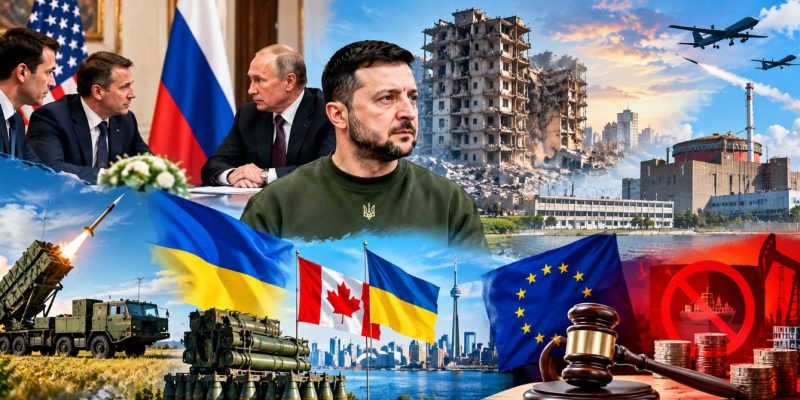
The week of September 5–12 was marked by intensified diplomatic contacts between the United States, Kyiv and Moscow, new large-scale attacks on Ukrainian cities and infrastructure, and expanded international military and sanctions support. At the same time, the International Atomic Energy Agency secured a local ceasefire to allow repairs to the power supply line at the Zaporizhzhia Nuclear Power Plant, while Canada announced a new aid package.
Related: Weekly Digest of Events in Ukraine (August 29 – September 5, 2026): a brief overview
The United States sought to restart the negotiation process
On September 5–7, U.S. representatives Steve Witkoff and Jared Kushner held talks first in Moscow and then arrived in Kyiv. In the Russian capital, they met with Vladimir Putin before discussing possible options for further negotiations with Volodymyr Zelenskyy and the Ukrainian delegation.
According to Reuters, no breakthrough was achieved in Moscow, but the U.S. representatives said new ideas had emerged and that trilateral talks involving the United States, Ukraine and Russia could resume soon. Zelenskyy described the discussion with the American delegation as substantive and said it also covered air defense supplies, energy support ahead of winter, security guarantees and possible economic mechanisms for post-war reconstruction. Control over territories, particularly the situation in Donbas, remains the key unresolved issue.
Kyiv came under another large-scale attack after the diplomatic pause
During the visit of the American negotiators, Moscow and Kyiv temporarily halted attacks on each other’s capitals, but the strikes resumed after the talks ended. On the night of September 8, Russian missiles and drones attacked Kyiv.
According to city authorities and emergency services, five people were killed and 35 were injured. At least 14 apartment buildings, a dormitory, a school, a clinic, warehouses and other facilities were damaged. Strikes in other regions also affected railway infrastructure: around 100 people were evacuated from a train in the Sumy region, while a railway worker was killed in Zaporizhzhia after a strike hit a passenger train. Ukraine again appealed to its partners to increase supplies of interceptor missiles to counter ballistic missiles.
Zaporizhzhia Nuclear Power Plant received a window for emergency repairs
On September 5, a local ceasefire around the Zaporizhzhia Nuclear Power Plant took effect after being brokered by the IAEA. It was necessary to repair a damaged power line and clear mines from the area where Ukrainian specialists were expected to work.
The plant, which has been under Russian control since the first weeks of the full-scale war, had been without external power since August 20 and was using emergency diesel generators to maintain its safety systems. The IAEA warned that without restoring the power supply or securing additional fuel deliveries, the plant could face a complete loss of electricity. Russia said the ceasefire could last for about a week, while Moscow and Kyiv continued to accuse each other of actions that created risks to nuclear safety.
Canada announced a new aid package and expanded cooperation
On September 10, Volodymyr Zelenskyy visited Canada, where he met with Prime Minister Mark Carney. Following the talks, Canada announced a support package that includes about $2 billion for Patriot missiles, F-16 ammunition, joint drone production and energy projects.
Reuters separately reported on a package worth 350 million Canadian dollars for air defense systems, as well as plans to expand drone production. Canada expects to manufacture millions of drones over the next two years, with some intended for delivery to Kyiv. The two sides also signed documents on a 100-year partnership and cooperation in the defense and energy sectors.
Attacks on cities and infrastructure continued
Air strikes continued during the second half of the week in Kyiv and the Dnipropetrovsk, Zaporizhzhia, Kharkiv and other regions. On September 11, Russian drones attacked two gas stations in Kyiv, killing two people and injuring at least 12 others, including a child.
In the Dnipropetrovsk region, regional authorities reported deaths and injuries, while damage was also recorded in Zaporizhzhia and Kharkiv. At the same time, Ukrainian drones continued striking targets deep inside Russian territory, including oil and logistics infrastructure. By the end of the week, AP reported further attacks on Zaporizhzhia, Kryvyi Rih and Odesa, where civilian facilities were damaged and casualties were reported.
Kyiv discussed stronger sanctions pressure
On September 10, a two-day international forum on sanctions against Russia began in Kyiv, bringing together representatives of 22 countries and the European Union. The discussions focused on restrictions in the energy sector, supplies of components for Russian missiles and drones, companies involved in the military-industrial complex, the financial sector and maritime transportation.
At the same time, work continued in the United States on legislation introducing new sanctions against Russia. The Senate had previously approved the bill by a vote of 86 to 11, while the House of Representatives was expected to consider its further progress. The legislation предусматривает sanctions against Russian officials and the possibility of imposing high tariffs on major buyers of Russian energy resources.
The main trends of the week were the combination of diplomatic efforts to resume negotiations with the continuation of intense fighting and air attacks. At the same time, international partners focused on strengthening Ukrainian air defenses, energy resilience and sanctions pressure on Russia.