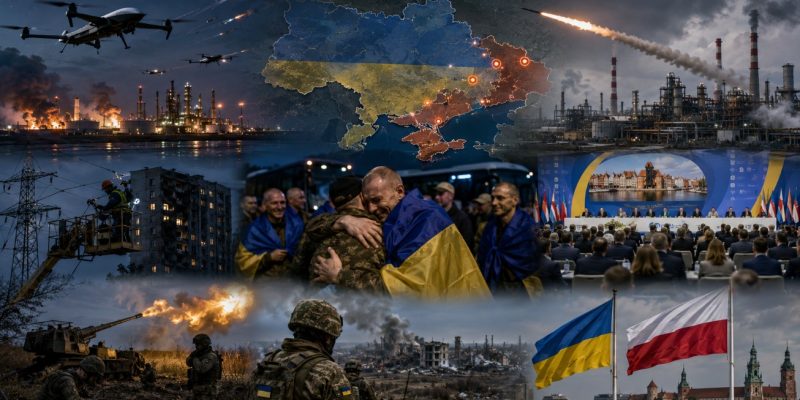
Over the past week, Ukraine saw intensified warfare marked by expanded drone strikes and reciprocal long-range attacks on Russian territory and occupied regions. At the same time, Kyiv stepped up diplomatic engagement at an international recovery conference in Gdańsk, while prisoner exchanges between Ukraine and Russia continued under established humanitarian frameworks. The week was also defined by sustained pressure on critical infrastructure and ongoing combat activity across multiple frontlines.
Related: Weekly Ukraine Digest (June 14–20, 2026): the week’s top stories at a glance
Escalation of drone warfare and battlefield activity
Ukraine significantly increased the use of unmanned aerial systems in strikes targeting infrastructure across Russia and occupied Crimea. Western media reported repeated waves of drone attacks aimed at energy facilities and logistical hubs supporting Russian military operations. Russian authorities claimed interception of hundreds of drones in large-scale overnight attacks during peak activity periods.
In occupied Crimea, local administrations introduced emergency measures, including fuel rationing and temporary disruptions in electricity supply. Ukrainian officials described the campaign as part of a broader strategy to degrade Russian logistics capacity, while Moscow reported damage to civilian and energy infrastructure.
Strikes on Russian military and industrial infrastructure
Ukrainian forces carried out attacks on industrial and military-linked sites deep inside Russian territory, including facilities in the Volgograd region associated with defense production. Kyiv stated that the operations were intended to reduce Russia’s capacity to manufacture missiles and artillery systems.
Russian authorities reported casualties and localized damage to industrial sites. Additional strikes were directed at fuel storage and processing infrastructure, which analysts say may affect supply chains supporting Russian military operations.
Prisoner exchanges between Ukraine and Russia
Ukraine and Russia conducted another prisoner swap during the week, with approximately 160 individuals released in a reciprocal exchange. The agreement involved military personnel from both sides and was described as one of the larger exchanges in recent months.
Ukrainian officials said humanitarian negotiation channels remain one of the few functioning areas of structured contact between Kyiv and Moscow despite ongoing hostilities.
Ukraine Recovery Conference in Gdańsk
The Ukraine Recovery Conference (URC 2026) took place in Gdańsk on June 25–26, co-hosted by Ukraine and Poland. Government representatives, international financial institutions, and private sector actors participated in discussions on reconstruction priorities.
Key topics included rebuilding critical infrastructure, restoring the energy sector, and securing long-term financing for Ukraine’s defense and recovery needs. Participants emphasized the role of private investment and European integration mechanisms in post-war reconstruction planning.
Ukraine–Poland diplomatic tensions
Relations between Kyiv and Warsaw experienced renewed tension amid political disputes over symbolic and historical issues in Poland. Polish Prime Minister Donald Tusk stated that escalating political conflict between the two countries could have negative implications for regional security and economic cooperation.
Despite disagreements, both sides reiterated their commitment to maintaining strategic partnership amid the ongoing war with Russia.
Ongoing military situation and frontline developments
Intense fighting continued across eastern and southern Ukraine throughout the week. Russian forces reported localized advances in parts of the Dnipropetrovsk region, while Ukrainian troops maintained defensive and counteroffensive operations along southern axes.
Ukraine also faced sustained drone and missile attacks on civilian areas, resulting in casualties and damage to infrastructure in several cities.
Conclusion
The week of June 21–27, 2026 was characterized by intensified drone warfare, expanded strikes on deep targets, and continued attritional combat along the front lines. Diplomatic and humanitarian channels remained active, particularly through prisoner exchanges and international reconstruction discussions. The conflict continues to evolve into a prolonged war of attrition with widening geographic and technological scope.