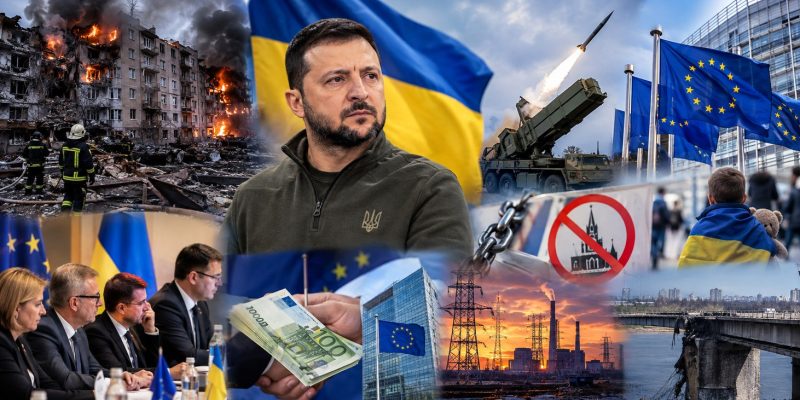
The week of September 27 – October 3 was marked by intensified Russian air strikes, including attacks on Kyiv, energy and telecommunications infrastructure. At the same time, authorities discussed additional defense funding, the EU expanded sanctions over the deportation of Ukrainian children, and international partners confirmed financial and military support amid preparations for the winter.
Related: Weekly Digest of Events in Ukraine (September 19–26, 2026): key developments
Russia intensifies strikes on Kyiv and infrastructure
On September 27, Russian drones attacked Kyiv and other regions. Two people were killed and about ten injured in Sofiivska Borshchahivka near Kyiv. In the capital itself, strikes on residential facilities and other damage were reported; Kyiv also suffered damage to telecommunications infrastructure. Kyivstar confirmed that its headquarters had been damaged. Russia’s Defense Ministry said it had struck military infrastructure, although Reuters could not independently verify some of the reported targets.
On September 28, the attacks continued. In Kyiv, the National Academy of Sciences complex was damaged, two people were killed and another 24 injured. Across the country, at least ten people were reported killed and more than 80 injured. In Dnipro, a strike on a business center killed three people and injured 19. Reuters noted the use of jet-powered drones, which fly faster than conventional models.
Energy and transport infrastructure also came under attack
On September 30, Russia launched a new series of strikes against energy infrastructure. According to Reuters, the attack was part of an expected campaign against the power system ahead of the winter period: one person was reported killed and five injured in the Kyiv area, while energy facilities were also damaged. Ukrainian authorities simultaneously said that air defenses needed to be strengthened.
On October 1, a Russian drone damaged a school in Kyiv. More than 100 students were sheltering there and were not injured. The Southern Bridge over the Dnipro was also damaged, disrupting traffic. On October 3, Kyiv Mayor Vitali Klitschko reported damage to the Northern Bridge; traffic on it was temporarily halted. Authorities link the attacks to continued pressure on critical infrastructure, while Russia says it is striking military and related facilities.
Kyiv announces new weapons and continues operations against Russian targets
On October 1, Volodymyr Zelenskyy said that Ukraine had used the FP-7 tactical ballistic missile in combat for the first time. According to Reuters, the missile, developed by Fire Point, has a range of about 200 km. The president did not say which specific target it was used against. Ukraine is also working on the longer-range FP-9, which it plans to put into service by the end of the year.
Russian authorities during the same period reported Ukrainian strikes on oil infrastructure. On October 1, Vladimir Putin said that attacks by Ukrainian forces on Russian oil refineries had reduced Russia’s economy by about 1%, and announced retaliatory measures. Moscow also extended restrictions on diesel fuel exports.
EU imposes new sanctions over deportation of Ukrainian children
On September 28, the Council of the EU added ten individuals and 17 organizations to its sanctions list, which European authorities say are responsible for the unlawful deportation and forced transfer of Ukrainian children to Russia and occupied territories. The restrictions include asset freezes and a ban on providing economic resources to the listed individuals and entities. The decision forms part of the EU’s existing sanctions regime targeting individuals and structures involved in violations of territorial integrity and sovereignty.
On September 28–29, an international conference on the return of Ukrainian children, detained civilians and prisoners of war was held in Toronto. In the final document, participants reaffirmed the need to comply with international humanitarian law and continue international cooperation on the return of displaced persons. The document was supported, among others, by Canada, Norway, the EU, the United Kingdom, the United States and a number of European states.
EU and EBRD confirm financial support
On October 1, the European Commission and Kyiv said they had secured sufficient resources to cover the country’s budgetary and defense needs in 2026. A significant part of the funding comes from an EU loan package worth €90 billion for 2026–2027. The sides also discussed accelerating the provision of funds for 2027 subject to the fulfillment of agreed conditions and reforms.
On October 2, the European Bank for Reconstruction and Development said it planned to provide about €2.7 billion in 2026, compared with €2.9 billion in 2025. More than 80% of current financing is intended for the private sector. The EBRD is also supporting the protection of energy infrastructure and renewable energy projects with a combined capacity of 1.4 GW. At the same time, the bank lowered its forecast for economic growth in 2026 from 2.2% to 1.5%.
Government seeks additional $27 billion for defense
On September 27, Prime Minister Serhii Koretskyi said there was a $27 billion shortfall in defense funding. According to him, the government expects to obtain about $7 billion through savings and the reallocation of domestic spending, while the remaining amount is expected to come with the help of external partners. Some of the funds are needed immediately to prepay for supplies that are due to arrive in the first quarter of 2027.
At a meeting with EU representatives, Defense Minister Yevhen Khmara said that about one-third of the additional requirement was related to prepayments for drone deliveries scheduled for early 2027. The government is also seeking faster access to European financing and the use of funds from the SAFE program for procurement.
At the end of September, the government approved the draft state budget for 2027. The document allocates UAH 4.885 trillion, or 43.8% of GDP, to defense and security. The draft must still go through the parliamentary process and may be amended during consideration.
Throughout the week, diplomatic contacts with European and North American partners continued, primarily on air defense, financing and preparations for the winter. On September 30, Zelenskyy discussed strengthening air defenses and support for Ukrainian F-16s in phone calls with Finnish President Alexander Stubb and Norwegian Prime Minister Jonas Gahr Støre.
The week ended with continued strikes on infrastructure and government preparations for the winter period. At the same time, major defense financing needs remain, while the EU and international financial institutions have confirmed continued support.