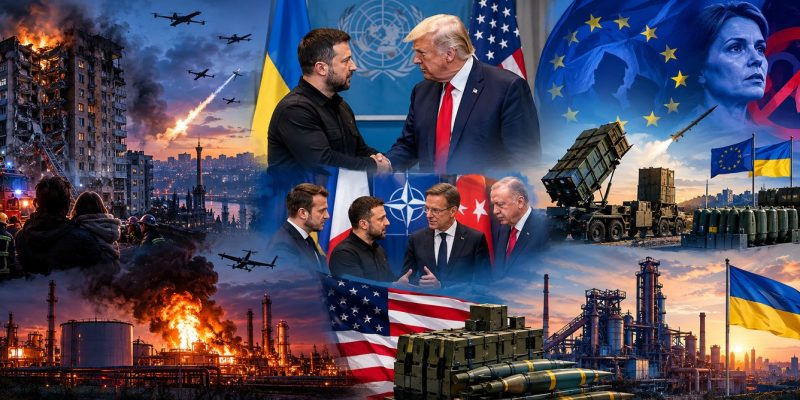
The week was marked by intensified Russian air strikes on Ukrainian cities and infrastructure, including a large-scale attack on Kyiv on September 25. At the same time, the diplomatic agenda shifted to New York, where Volodymyr Zelenskyy met with Donald Trump on the sidelines of the UN General Assembly and discussed possible steps toward de-escalation, air and missile defense, and preparations for the winter. The United States confirmed plans to allocate almost all of the previously approved $400 million in military assistance, while the EU extended individual sanctions. Ukraine also continued strikes against Russian oil infrastructure and expanded defense cooperation with European partners.
Related: Weekly Digest of Events in Ukraine (September 12–19, 2026): key developments
Russian strikes on Kyiv: September 25 becomes the deadliest day of the week
On September 25, Russian drones attacked Kyiv several times. In the morning, a UAV struck a 16-story residential building in the Pecherskyi district, killing a 14-year-old teenager and injuring residents. Later in the day, an office building in the Solomianskyi district was hit, killing another four people. By evening, authorities reported 43 people injured during the day, 25 of whom were hospitalized, including two children.
Kyiv had also come under a ballistic missile attack on September 24. According to Ukrainian authorities, civilian and infrastructure facilities were damaged. Russian air strikes continued on September 26, with new fires and casualties reported in the capital.
Zelenskyy and Trump discuss de-escalation and winter defense
On September 22, Volodymyr Zelenskyy met with U.S. President Donald Trump in New York during the 81st session of the UN General Assembly. According to Zelenskyy, the two sides discussed possible de-escalation steps that could open the way for diplomacy, as well as support for Ukraine ahead of winter. Particular attention was given to air and missile defense and efforts to establish Patriot interceptor production in Ukraine.
Before the meeting, Zelenskyy said he wanted to reach agreements on halting strikes against energy infrastructure. On September 23, speaking at the UN General Assembly, he warned that Ukraine would respond to Russian attacks if no agreement was reached. Moscow, meanwhile, did not demonstrate readiness for a broader halt to air strikes.
U.S. to allocate almost all of previously approved $400 million
The Trump administration formally committed to spending almost the entire $400 million previously allocated by Congress under the Ukraine Security Assistance Initiative. According to Reuters, commitments totaling about $307 million had been made by the beginning of the week, with another $93 million expected to be committed before the end of the fiscal year on September 30. The first deliveries include weapons, equipment and spare parts.
The new assistance package does not include scarce Patriot interceptor missiles. This remains a key issue for Kyiv amid an increase in Russian ballistic missile attacks. On September 24, Zelenskyy said an agreement had been reached on a new package of Patriot missiles, but he did not disclose the supplying country.
EU extends individual sanctions
On September 22, the Council of the European Union extended for three years, until September 22, 2029, individual restrictive measures against people and entities that the EU considers responsible for undermining Ukraine’s territorial integrity, sovereignty and independence. The list continues to include more than 3,000 individuals and entities. The restrictions include travel bans, asset freezes and a prohibition on making funds available to listed individuals and organizations.
During the review, the EU did not renew the listing of three individuals and one organization and removed three deceased individuals from the list.
On September 24, the EU separately imposed sanctions on Ksenia Fedorova, citing activities related to information manipulation and interference.
Ukraine intensifies strikes against Russian oil infrastructure
On the night of September 20, Ukraine launched a large-scale drone attack against the Moscow region. Russian authorities reported that more than 1,600 drones had been intercepted, including around 450 heading toward Moscow. Officials also reported deaths and damage to oil-refining infrastructure. Reuters noted that the attack took place on the final day of Russia’s parliamentary elections.
On September 23, Zelenskyy told the UN that Ukraine would continue strikes against Russia’s energy infrastructure if no agreement was reached on reciprocal restrictions on attacks. The following day, Kyiv continued efforts to expand international support for its defense industry. Zelenskyy said Ukraine had reached an agreement with Finnish President Alexander Stubb on the joint production of drone systems.
Strikes increasingly affect industry
On September 25, ArcelorMittal announced that it was suspending production at its facility in Kryvyi Rih, Ukraine’s largest steel plant. The company cited the inability to continue operations safely amid Russian air attacks. Reuters reported that ArcelorMittal expected to write off around $1 billion in assets.
The same day, attacks on Kyiv killed seven people and injured 58, according to Reuters’ initial figures; Ukrainian authorities later provided updated casualty figures for individual incidents.
The suspension of operations at a major steelmaking facility adds direct economic risks to the consequences of the war, including reduced industrial output, export capacity and tax revenues, as well as additional reconstruction costs.
Diplomatic contacts and defense agreements
In New York, Zelenskyy held a series of meetings with Ukraine’s allies. With French President Emmanuel Macron, he discussed a winter support package and additional SAMP/T air-defense systems. With NATO Secretary General Mark Rutte, he discussed Patriot interceptors and strengthening ballistic missile defense. With Turkish President Recep Tayyip Erdogan, discussions focused on Black Sea security, restoring the maritime export corridor and potentially expanding defense-industrial cooperation.
Conclusion
By the end of the week, two tracks were developing simultaneously: intensified air strikes and diplomatic efforts to reach limited agreements, primarily concerning energy infrastructure and security. Key issues for the coming period include the state of Ukraine’s air defenses, protection of energy infrastructure ahead of winter, the scale of U.S. and European assistance, and the possibility of agreements restricting attacks on critical infrastructure.